
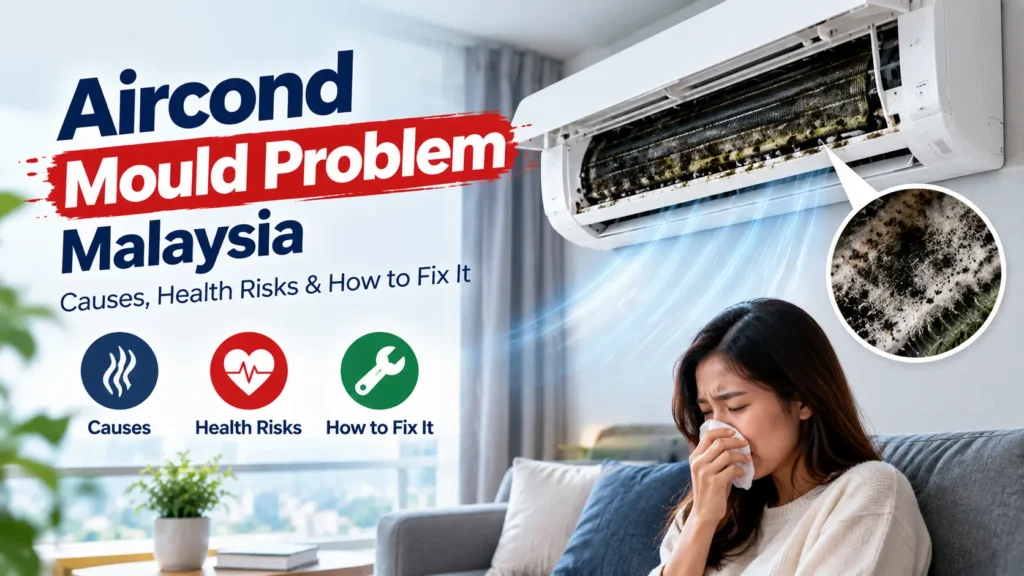
⚠️ Quick Answer
Mould inside your aircond means your unit is blowing mould spores directly into your room every time it runs. The fix is a professional chemical wash — or an overhaul for severe cases. The longer you wait, the worse the health risk, especially for children and the elderly.
Most people assume the bad smell from their aircond is just dust. It’s not. That musty, damp odour is mould — and every time your unit runs, it’s blowing mould spores directly into the air your family breathes. In Malaysia’s climate, this isn’t a rare problem. It’s extremely common, and it’s almost certainly worse than you think.
Our team at KedaiAircond.my cleans heavily moulded airconds every single week across KL and Selangor. When we open some of these units, the blower wheel is completely black — packed solid with mould growth that’s been accumulating for months or years. The homeowners had no idea it was that bad until we showed them photos.
📷 What we see inside
We’ve opened units where the blower wheel was completely black — packed solid with mould. Homeowners had no idea until they saw the photos. If you’re curious, we can show you what’s inside your unit too.
This guide covers what’s actually happening inside your unit, the real health risks for your family, and exactly what it takes to fix the problem permanently — not just mask it.
Suspect mould in your aircond?
Don’t keep running it. WhatsApp us — we’ll tell you how serious it is and get it fixed the same day. Free diagnosis, transparent pricing.
Why Malaysian Airconds Get Mould So Much Faster
Malaysia’s climate is almost perfectly designed to grow mould inside air conditioners. It’s not a matter of whether your unit will develop mould — it’s a matter of when, and how bad it gets before you notice.
Here’s what makes Malaysia particularly harsh:
🌡️ Year-Round Heat
At 26–32°C all year, your aircond runs every single day — often 8 to 10 hours daily. Every hour it runs, moisture condenses on the evaporator coil. That moisture never fully dries out in Malaysia’s climate.
💧 Extreme Humidity
Average relative humidity in Klang Valley sits between 70% and 90%. Mould only needs 60% humidity to grow. Malaysia gives it 30% more than it needs, virtually every day of the year.
🏠 Sealed Homes
Malaysian homes keep windows shut for most of the day. This creates a closed loop — the same humid air recirculates through your aircond repeatedly, depositing more moisture on the coil each pass.
🌧️ Monsoon Seasons
Two monsoon seasons per year (Southwest May–September, Northeast October–March) push humidity to near 100% for weeks at a time. Units that aren’t regularly cleaned develop heavy mould growth during these periods.
💡 What this means for your unit
A brand new aircond in Malaysia can develop visible mould inside the evaporator coil within 6 to 9 months of regular use without proper maintenance. In coastal areas like Port Klang or Pandamaran, this timeline can be even shorter. This isn’t a sign your unit is faulty — it’s just the reality of operating an aircond in this climate.
Where Exactly Does Mould Grow Inside Your Aircond?
Understanding where mould lives inside your unit is important — because it explains why simply cleaning the filter does nothing, and why a proper chemical wash is the only real fix.
| Location Inside Unit | Why Mould Grows Here | Reachable by Filter Clean? |
|---|---|---|
| Evaporator coil | Constant moisture from condensation. Prime mould surface. | ✗ No |
| Blower wheel | Trapped behind coil. Mould packs between fins. Main source of smell. | ✗ No |
| Drain pan | Standing water collects here. Algae and mould thrive in stagnant water. | ✗ No |
| Drain pipe interior | Dark, wet, never dry. Mould and algae block drainage causing leaks. | ✗ No |
| Air filter | Traps particles including mould spores from the air. | ✓ Yes |
| Unit casing interior | Plastic surfaces in humid environment develop surface mould over time. | ~ Partial |
🚨 The filter cleaning mistake
Cleaning the filter is like washing the lid of a pot but leaving the pot full of mould inside. 5 of the 6 locations where mould actually lives in your aircond are completely unreachable by a basic filter clean. Many people clean their filter regularly and still smell mould — because the filter was never the source to begin with.
What Types of Mould Grow in Malaysian Airconds?
Not all mould is the same. The types found in Malaysian airconds range from mildly irritating to genuinely dangerous — and knowing the difference helps you understand why the health warnings in this guide are not exaggerated.
Cladosporium
Most common in Malaysia
Green or black appearance. Found on coil fins and inside casings. Triggers allergic rhinitis, skin irritation, and can worsen existing asthma. Very common in airconds that haven’t been cleaned in 6+ months.
Aspergillus
Potentially serious
White, yellow, or green fuzzy growth. In healthy adults causes allergic reactions and sinus issues. In people with weakened immune systems, can cause a serious lung infection called aspergillosis. Found in drain pans and wet surfaces.
Penicillium
Common irritant
Blue or green colour. Grows rapidly in damp environments. Strong respiratory irritant — causes coughing, wheezing, and eye irritation. Particularly problematic for people with dust mite allergies as sensitivities often overlap.
Stachybotrys (Black Mould)
Rare but most serious
The most feared type. Slimy black appearance. Produces mycotoxins that can cause severe respiratory damage, neurological symptoms, and chronic fatigue. Rare in airconds specifically — more common in water-damaged walls and ceilings. If found in your unit, immediate professional intervention is necessary.
The Real Health Risks — What a Mouldy Aircond Does to Your Family
This is the part most people don’t fully appreciate. It’s not just about the smell. When your aircond runs with mould inside, it acts as an aerosol — blasting microscopic mould spores directly into the air at fan speed. Every person in that room breathes those spores in.
The World Health Organization classifies indoor mould exposure as a significant public health concern. In Malaysian homes where windows stay closed and the same air recirculates for hours — the concentration of airborne mould spores from a contaminated aircond can reach levels that would be considered concerning in workplace health assessments.
📷 We’ve seen units 10x worse than this
The blower wheel in this photo is from a typical KL home. We’ve opened units where the entire wheel was completely black — packed solid with mould. Your family breathes that air all night if you don’t act.
For Adults
- Persistent coughing and sneezing — especially in the mornings or after being in the aircond room, that you might be attributing to weather or dust
- Chronic sinusitis — recurring blocked or runny nose that doesn’t clear up normally
- Eye and throat irritation — itchy, watery eyes and a scratchy throat that appears when you’re in specific rooms
- Worsening asthma — mould spores are one of the most potent known asthma triggers. Studies show mould exposure increases asthma attack frequency by 30 to 50 percent in sensitive individuals
- Headaches and fatigue — some mould species release VOCs (volatile organic compounds) that cause these symptoms with prolonged exposure
🚨 For Children Under 12 — Read This Carefully
Children’s immune and respiratory systems are still developing. Their breathing rate is faster than adults — meaning they inhale proportionally more air (and more spores) per minute. Children who sleep in rooms with mouldy airconds running overnight are particularly at risk.
Signs in children that are sometimes missed: recurring coughs that “won’t go away,” frequent ear infections, unexplained skin rashes, and repeated respiratory infections that keep coming back. We’ve spoken to parents who were going to doctors monthly for their child’s recurring cough — until they had their bedroom aircond chemically washed. The cough cleared within weeks.
If your child sleeps under an aircond that hasn’t been properly cleaned in over a year — please act on this today, not next month.
⚠️ Elderly and immunocompromised individuals
Elderly family members and anyone with a weakened immune system — including those on long-term medication, recovering from illness, or undergoing treatment — face more serious risks from Aspergillus species commonly found in neglected airconds. If you have elderly parents or grandparents living with you, the bedroom aircond they sleep under deserves priority attention.
How Mould Spreads — Why It Gets Worse Over Time
Mould doesn’t stay contained once it starts. It spreads actively and aggressively — and your aircond helps it do this faster than almost any other indoor source.
Here’s what happens inside your unit once mould takes hold: Mould produces spores constantly. Your blower fan — running at several hundred RPM — picks up those spores and blasts them into your room. Some spores land on your walls, soft furnishings, carpets, and mattress. In Malaysia’s humidity, those secondary spores find new surfaces to colonise. Within months, you can have a mould problem that started in your aircond spreading to your bedroom walls and furniture.
The other thing mould does: it feeds on the organic material inside your unit — the dust, dead skin cells, and grime that accumulates on the coil and blower wheel. The more it eats, the faster it grows. A coil that had surface mould in January can have severe deep mould by June if left untreated.
This is why the advice to “just run the aircond longer to dry it out” doesn’t work. You can’t dry out a blower wheel by running the unit — air passes over the wheel but the packed mould between the fins never fully dries in Malaysian humidity. The only way to remove it is physical cleaning with chemical agents. For a detailed look at what signs indicate your unit needs a chemical wash, we’ve covered this in full detail separately.
Stop Your Family Breathing Mould Spores
Our CIDB-certified technicians completely eliminate mould from your aircond using professional chemical agents — not just spray and rinse. Same-day service across KL & Selangor. From RM160 per unit.
How to Permanently Fix Aircond Mould — What Actually Works
There are a few approaches you’ll come across when researching this — from DIY sprays to full professional cleaning. Here’s the honest breakdown of what actually works and what doesn’t:
❌ What Doesn’t Work
- DIY anti-mould sprays — These reach the surface of the coil but don’t penetrate the blower wheel where 80% of the mould lives. They also can’t be properly rinsed without proper equipment, leaving chemical residue in the airstream.
- Air fresheners or deodorisers — They mask the smell for a few days. The mould keeps growing. This is one of the worst things you can do because it removes the warning signal while the problem gets worse.
- Running the unit on full blast “to dry it out” — Doesn’t work. The packed mould on the blower wheel stays damp in Malaysian humidity regardless of fan speed.
- Basic filter cleaning — Addresses the filter only. The coil, blower wheel, drain pan, and drain pipe remain contaminated.
✅ What Does Work — Chemical Wash
A professional aircond chemical wash is the only reliable solution for an established mould problem. Here’s what a proper chemical wash involves:
- The technician removes the front panel and filter and inspects the full extent of the mould
- A professional chemical cleaning agent is applied directly to the evaporator coil and allowed to penetrate — not just sprayed and immediately rinsed
- The agent breaks down and kills mould colonies at the cellular level — not just surface cleaning
- Blower wheel is cleaned as thoroughly as possible within the unit (for severe cases, this means overhaul — see below)
- Drain pan is physically cleaned and all biological growth removed
- Drain pipe is flushed completely to clear mould blockages and restore proper drainage
- Unit is tested to confirm cooling performance and drainage are back to normal
A proper chemical wash takes 60 to 90 minutes. Anyone who does it in 20 minutes hasn’t done it properly. The chemical needs time to work on the mould before rinsing. Full pricing for this service in KL and Selangor is in our chemical wash price guide for Malaysia 2026.
🔧 When You Need a Chemical Overhaul Instead
If your unit hasn’t been serviced for 2 or more years, or if the smell persists after a chemical wash — the mould has penetrated deep into the blower wheel in a way that chemical spray alone can’t fully reach. In this case, a chemical overhaul is needed.
A chemical overhaul means the unit is fully dismantled, the blower wheel is physically removed and soaked in chemical solution, every component is cleaned individually, and the unit is rebuilt and reinstalled. It’s more expensive and takes 2 to 3 hours — but it eliminates mould that a wash cannot reach. Read our full comparison of chemical overhaul vs chemical wash to understand which one your unit actually needs before you book.
Cost to Fix Aircond Mould — Malaysia 2026
Here’s what it costs to properly remove mould from your aircond across KL and Selangor:
| Service | Unit Type & HP | Price | Best For |
|---|---|---|---|
| Chemical Wash | Split Unit 1.0HP–1.5HP | From RM160 | Mild to moderate mould, serviced within 12 months |
| Split Unit 2.0HP–2.5HP | From RM190 | Mild to moderate mould, larger unit | |
| Cassette Unit 2.0HP–3.0HP | From RM250 | Commercial/ceiling units | |
| Chemical Overhaul | Split Unit 1.0HP–1.5HP | From RM220 | Severe mould, 2+ years no service, persistent smell |
| Split Unit 2.0HP–2.5HP | From RM280 | Severe mould, larger unit, full dismantling needed |
Prices include labour and chemicals. Final price confirmed before work starts. 1-month workmanship warranty included.
How to Prevent Mould from Coming Back
After a professional chemical wash, your unit is clean. The question is how to keep it that way. These habits, done consistently, will dramatically slow down mould regrowth:
The 3-Minute Rule Before Switching Off
Before you turn off your aircond for the night, switch it to Fan Only mode (no cooling, just fan) for 3 minutes. This circulates dry air through the unit and dries out the evaporator coil before it sits overnight. A damp coil sitting for 8 hours is prime mould territory. This one habit alone significantly slows mould growth. 💡 Not all remotes label it “Fan Only” — some call it “FAN” or “Air Circulation” mode. If you’re unsure, check your remote or ask us on WhatsApp.
Clean Your Filter Every 2 to 4 Weeks
A clogged filter restricts airflow, which means more moisture lingers on the coil for longer — exactly the conditions mould thrives in. Wash your filter with water, let it dry completely, and replace it. This takes 10 minutes and makes a real difference to how quickly mould returns.
Professional Service Every 3 to 4 Months
Basic servicing — filter clean, drain check, coil inspection — every 3 months catches mould in its early stages when it’s easiest and cheapest to remove. This is especially important for coastal areas and homes near industrial zones where particulate levels are higher.
Full Chemical Wash Every 6 to 12 Months
Every 12 months for inland Klang Valley homes. Every 6 to 9 months for coastal areas, high-use units, or homes with pets. This regular chemical wash is what prevents mould from ever reaching the “severe” stage. Prevention is always RM160. Neglect becomes RM220 to RM280 for an overhaul. For a complete maintenance schedule, see our full aircond maintenance guide for Malaysia.
Ventilate the Room When Possible
When weather permits — particularly in the morning before the heat peaks — open windows for 20 to 30 minutes to allow fresh air exchange. This reduces the concentration of mould spores in the room air and gives the room a chance to air out.
Serving KL, PJ, Shah Alam, Subang, Klang, Cheras & all Selangor areas
Chemical wash from RM160 · Same-day available · 1-month warranty · CIDB-certified team
Frequently Asked Questions
Can a mouldy aircond make you sick in Malaysia?
Yes — and this is more common than most people realise. A mouldy aircond continuously blows mould spores (Cladosporium, Aspergillus, Penicillium) directly into your room every time it runs. This causes or worsens respiratory irritation, allergic rhinitis, sinusitis, and asthma — especially in children under 12, the elderly, and anyone with a weakened immune system. In Malaysia, where airconds run 8 to 10 hours daily in sealed rooms, the exposure is significant. If family members have recurring unexplained coughs, sneezing, or allergies — a dirty, mouldy aircond is one of the first things to check.
How do I know if my aircond has mould and not just dust?
Dust produces a dry, stale smell that typically fades within minutes of the unit running. Mould produces a distinctly musty, damp smell — similar to wet clothes left in a washing machine too long. If the smell is still present after 20 to 30 minutes of running, it’s almost certainly mould, not dust. You can also open the front panel and look: mould appears as black, green, or brown spots or fuzzy growth on surfaces inside the unit. White or chalky deposits are more likely mineral buildup from condensation. Both need professional cleaning but mould is the health priority.
Will a chemical wash fully remove mould from my aircond?
For most cases — yes, a professional chemical wash completely removes mould and eliminates the smell. The chemical solution kills mould at the cellular level rather than just washing it off the surface. However, for units that haven’t been serviced for 2 or more years, the mould on the blower wheel may be too compacted for a chemical wash alone to fully reach. In those cases, a chemical overhaul — where the blower wheel is physically removed and soaked — is necessary. If your smell returns within 2 to 4 weeks of a chemical wash, that’s the signal you needed an overhaul instead.
How often should I chemical wash to prevent mould in Malaysia?
For most Malaysian homes in inland areas (KL city, Petaling Jaya, Subang Jaya, Shah Alam): once every 12 months minimum. For coastal areas (Port Klang, Pandamaran), homes with pets, or units running more than 10 hours daily: every 6 to 9 months. Combine this with a basic service every 3 to 4 months and the 3-minute fan mode habit before switching off — this routine prevents mould from ever reaching the severe stage. Regular maintenance is always significantly cheaper than treating a neglected unit.
Can I just use bleach or vinegar to clean mould myself?
No — this is a bad idea and can damage your unit. Bleach and vinegar will corrode your evaporator coil and void your manufacturer’s warranty. DIY cleaning with household chemicals can cause permanent damage to the coil, costing you RM1,000+ in replacement parts. Professional chemical agents are specifically formulated for aircond coils — they kill mould without damaging components. If the smell is bad enough that you’re considering bleach, just book a professional chemical wash. It’s RM160 to fix it properly, versus RM1,000+ to replace a damaged coil.
Get Your Aircond Mould Fixed Today
Don’t keep your family breathing mould-contaminated air. Our CIDB-certified team removes mould completely — same-day slots available across KL and Selangor. Price confirmed before we start.
Jerry Bee
Founder, KedaiAircond.my · CIDB-Certified Aircond Specialist · 10+ Years Servicing KL & Selangor
Jerry has opened thousands of aircond units across KL and Selangor since 2014. The health information in this guide reflects what he and his team observe in real jobs every week — not textbook descriptions. When he says mould is more common and more serious than most people think, it’s because he sees the inside of Malaysians’ airconds daily.
Related Guides